Outreach & Education
Learn about outreach and education initiatives associated with PRISM
The McGill-STRI Neotropical Environment Option
Dr. Brian Leung, chair of PRISM, also serves as the director of McGill’s Neotropical Environment Option (NEO) program.
The NEO program is a research-based option for Masters and PhD students, offered in collaboration by McGill University and the Smithsonian Tropical Research Institute (STRI). It is a program aimed at students who wish to focus their graduate research on environmental issues relevant to the Neotropics and Latin American countries. As such, students’ research is completed in Latin America, and NEO’s core and complementary courses are taught in Panama. Students are co-supervised by faculty from McGill and an institution from their focal country, and spend time working in both places, fostering cross-institutional collaborations and diverse partnerships.
NEO’s educational framework is focused on interdisciplinary approaches to research and welcomes students from a wide range of disciplines, including students in the departments of Anthropology, Biology, Bioresource Engineering, Geography, Natural Resource Sciences, Plant Science, and Political Science. The courses offered by NEO are also highly multidisciplinary, combining natural and social sciences, to give students better contextualization of the challenges faced by Panama, and other areas in the Global South.
The central aim of the NEO program is facilitate a broader understanding of tropical environmental issues and the development of skills relevant to working in the tropics. If you’d like to learn more about NEO, you can contact Brian Leung at brian.leung2@mcgill.ca.
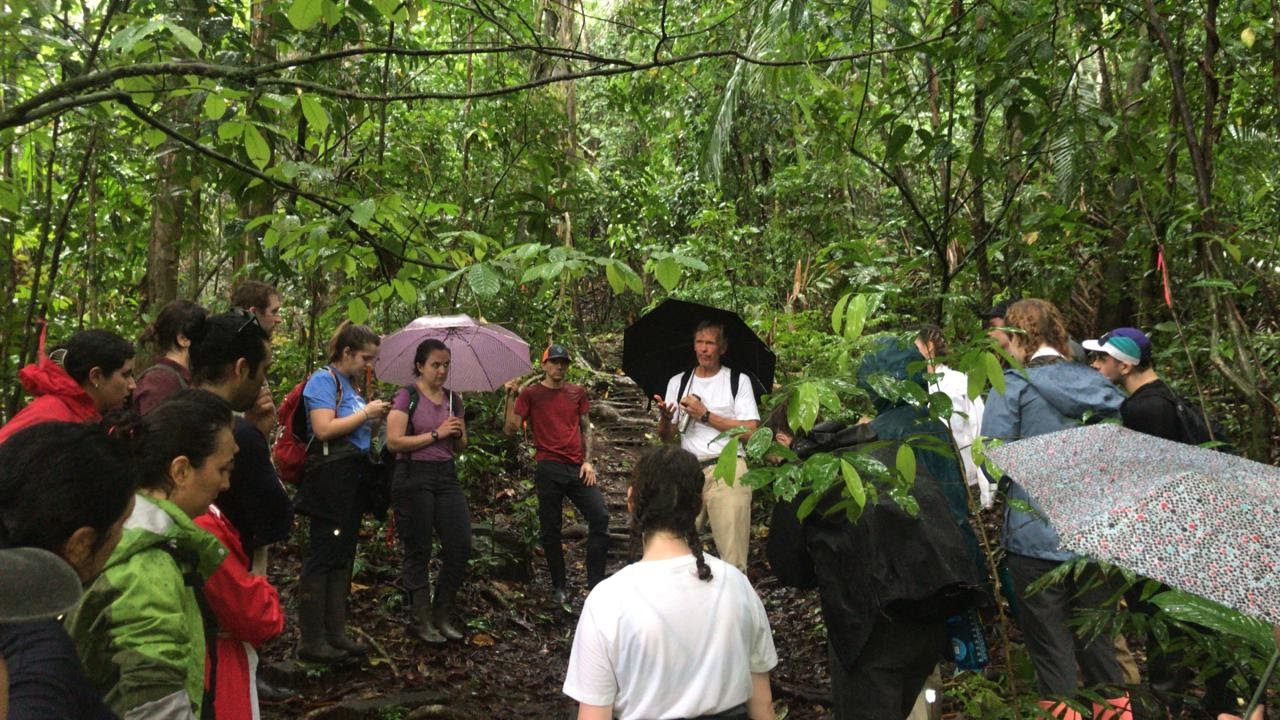
Figure: Students, including many NEO students, joined by Joseph Wright (STRI) at the 50-hectare permanent tree plot on Barro Colorado Island, Panama.
Experiential learning:
Conservation and sustainability do not occur in isolation, but are a product of the interaction between people and their environment; this interaction is contextual to the values and livelihoods of those peoples.
NEO's core courses provides an interdisciplinary, integrative experience between the natural and social sciences. Courses are immersive, wherein NEO students traveled together across Panama to learn about conservation across biomes, from terrestrial forests to marine ecosystems, and the diverse research that is done across the country. For instance, in the past, the class went to Barro Colorado Island, which was formed when Lake Gatun was created from flooding due to the creation of the Panama Canal, and where tropical forest research has been conducted for 100 years. They visited the Indigenous Ipeti-Emberá community, in the Bayano region of Panama, where a reforestation effort is currently ongoing, in partnership with McGill’s Office of Sustainability. They learned about marine conservation, mangroves and coral reefs in Bocas del Toro, on the western end of Panama, in the Caribbean Sea, and in Coiba National Park, which has evolved from a penal colony to a marine biodiversity sanctuary. In each site, the instructors, in concert with local stakeholders and community members would introduce both ecological and social issues and challenges.
The immersive, experiential nature of the NEO courses emphasizes for the students that their work touches upon not just environmental conservation, but also real communities, people and their livelihoods. This consideration across disciplines and perspectives allowed the students to position their own research, and better understand the context of their own work.
Words from NEO students:
Antonio Rodriguez-Campbell:
Ariadna Mora:
Hannah Waldman:
Kiho Hazelton-Cook: